
Sailing in Circles
“Prepare to…No, I mean…. Ready about!” I shouted as I glanced up, around and behind me, then up again at the wind vane on the top of the mast. We were in a close reach, or close haul, or maybe a pinch.
“Ready!”
“Ready!” My two crew mates grasped the jib sheets.
“Helms-a-lee!” I remembered that call properly and pulled the tiller left toward me, then corrected myself. We were turning to port, so I needed to push it to the right, I mean, to starboard, toward my instructor.
The mainsail swung across the cockpit in a short arc, the main sheet catching the boom. The jib luffed then fell as one crew mate eased off her sheet while the other hardened up as we passed through the wind.
I glanced up at the wind vane to stop the turn in a close reach, focused intently on the little arrow and its v-shaped indicators to tell me when I was out of irons and into my starboard tack. While my brain processed that little vane, it was not focused on the wind on my face or the kayaker or the sail boat or the piers, at least for a few seconds of forced decisions and information overload.
I was at the helm of a Catalina 22 in the middle of Marina Del Rey, thinking a lot about clinical pedagogy.
Our instructor sat across from me, kicked back against the stern pulpit, nonplussed, a salty-dog sailor, who was also a screenwriter with some work in IT (in LA, naturally), and with, as I would later learn, degrees from Yale and Harvard. He said, “Pick a landmark, keep it in the middle of the pulpit. Don’t steer too much. Your sail is luffing. Harden up. Okay, steer a little more than that. Keep on this line. Watch out for that boat. What tack are they on?”
“Um. Port? Port.”
“Right, so do we stand on or give way? “
“Um, we… Um, we, we stand on.”
“Right. Who’s next? Let’s rotate.”
So I shifted up to take a jib sheet while a class mate took the helm before we fell away to a beam reach, then to a broad reach, before we prepared to jibe, then actually jibed. She yelled, “Jibe ho!” which I had not gotten to do yet but which sounded cool. I relaxed my shoulders and saw everything I couldn’t notice while I was at the helm.
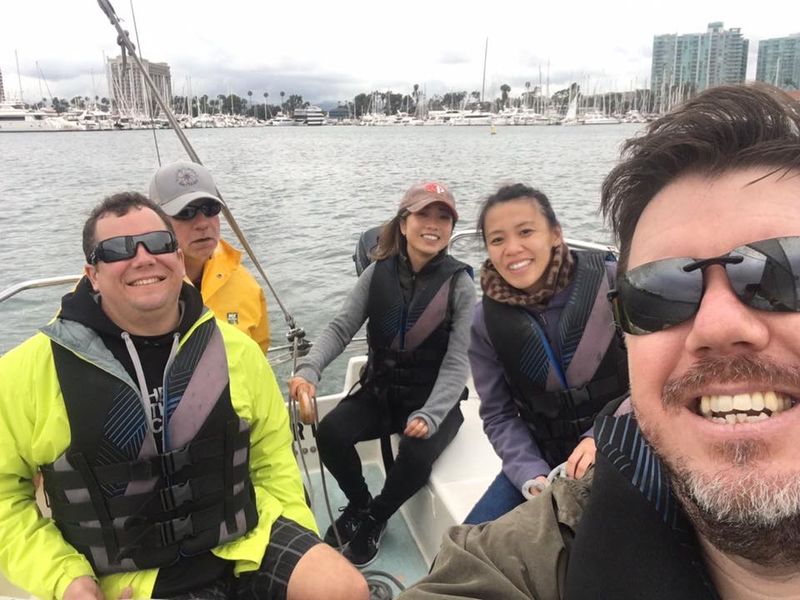
For my fortieth birthday, my wife got me sailing lessons, Basic Keelboat, the 101 course for the American Sailing Association at Bluewater Sailing. Since we had moved to our university overlooking the Santa Monica Bay three years ago, I had been pining for the sea, so she gave me a shot. For four days over two weekends, my crew of four and our instructor learned and practiced the basics. For a week, I had stress dreams about tying knots.
In the first week, I noticed that the terminology was my greatest distraction. Conceptually, I was getting it, but articulating all of these things quickly took the most mental focus. When we got underway, then started making way, after just an hour or so of basic orientation on shore, I was thrilled to be on the water. But when I was at the tiller, in a crowded marina, I had near-sighted tunnel vision on every task.
I had to focus on that wind vane constantly to reckon my point of sail, but I couldn’t do that while I was trying to remember to push the tiller in the opposite direction we needed to turn, while trying to remember whether to harden up or ease off the sail, to head up into the wind or to fall off, while all the time remembering the sailing words to use for all of those things. Our instructor made us narrate them every time, making us say what we were going to do before we did it, then to say it was we did it, then to do it all again. I sure hoped he or someone was paying attention to whatever we might hit, because I surely wasn’t.
He would have made a great clinical teacher, demanding but never worried we would collide with anything, even as he let us drift awfully close to disaster.
Prepare. Perform. Reflect. Prepare. Perform. Reflect.
We sailed in circles for the entire first day, through all the points of sail. Heading up from the broad reach to the beam reach to the close reach, coming about through the wind, into a close reach, falling off to a beam reach, to a broad reach, jibing away from the wind, then back again. Round and round and round, while all the other boats headed out to sea.
It reminded me of my first judicial hearing in real life, when a partner needed to tell me where to sit in the courtroom. How I was intently focused on the judge and my notes and how everything else dissolved into fuzzy notions of bailiffs, clerks, opponents, who were all there but who I couldn’t recognize while blood rushed through my ears. It reminded me of sitting in a law library in my firm, surrounded by books that I swore someone had once taught me to use when I was a 1L but that I now felt incapable of using like an expert.
It reminded me of a 3L who would ask me whether he has to cite the case he’s discussing in the memo. Yes, you always cite everything. Yes, cite it in a footnote. Yes, with the Bluebook. LRW was more than just sitting on the pier with a model. You have to take this thing out in the water and use it.
This is experiential learning.
The fourth and final day of the course, we sailed out into Santa Monica Bay with my crew, on a boat without a wind vane on the mast. We felt the wind. We could see it on the sails. We were in a port tack, and I needed to ease up that main sheet to keep our line on a broad reach. I knew how to sail that little Catalina 22 over six-foot swells and around that racing buoy and back again, because I had sailed in circles for days, chanting the turns and orders like a mantra. The final day, I didn’t have to dig deep to remember what to say. I just said it, and I knew what it meant because I could see where I wanted to go, could feel the wind on my face and could watch those sails react.
We could have talked all day about points of sail with a white board and a model, but we didn’t learn to sail on the ocean until we worked together under real sails in real wind on real water. We began confused, confounded and exposed in our novice ways, but by sailing we were becoming sailors.
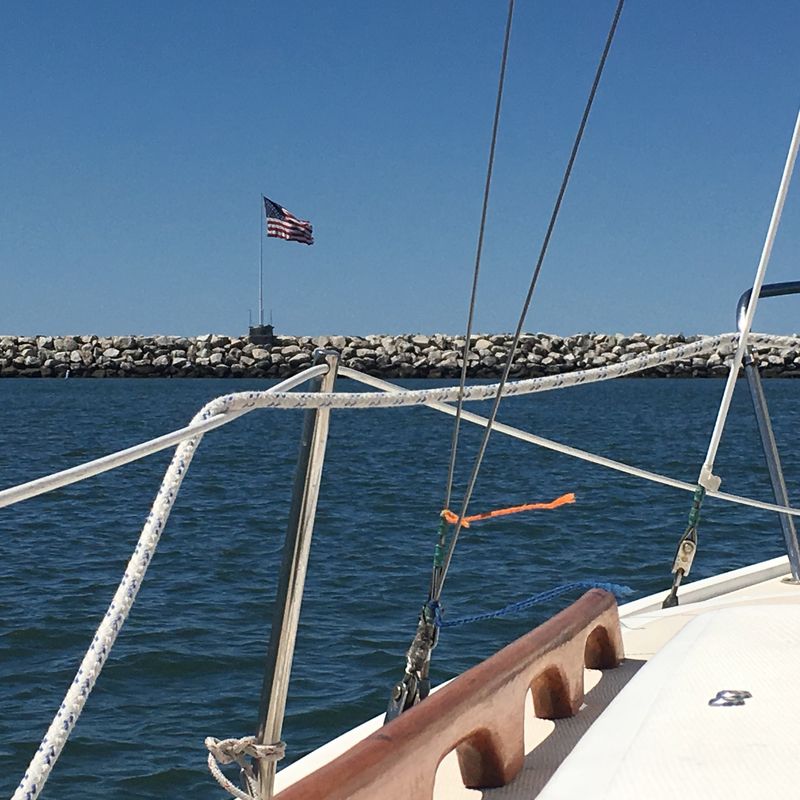
The last day, I didn’t have tunnel vision. I saw all the other traffic on the water while our crew shared stories about our lives and work. We jibed all the way into the marina with the wind at our backs, calling out orders and turns while hardening up and easing off our sails, judging distance and angles, laughing and answering questions, giving and receiving advice. I was making plans to get my family out on the water as skipper of my own boat.
That reminded me of the student who was terrified to meet with a client alone for first time in a semester, who shrank from the weight of a client’s trust, who doesn’t trust herself to make a real-time decision, but who, just weeks later, is briefing her fourth client on the law with confidence in her own preparation. It reminded me of the student who is utterly stymied when he realizes his facts don’t come in a hypothetical and who can’t even identify the issue he’s supposed to spot, but who, ten weeks later, argues in court with a precise, prepared, creative presence of mind.
They were stumped by the jargon then stupefied by all of the information they needed to process as their instructor told them to sail in circles. After turning through the points of sail, over and over, reciting their lines, learning the wind, watching the sails, feeling the tiller, taking in more and more of the boat’s reaction in the water, the instructor finally said, “Come about and head to sea.” Then the horizon opens up, and the glittering water reflects a bright sky. The sails fill, and the boat cruises out of the harbor.
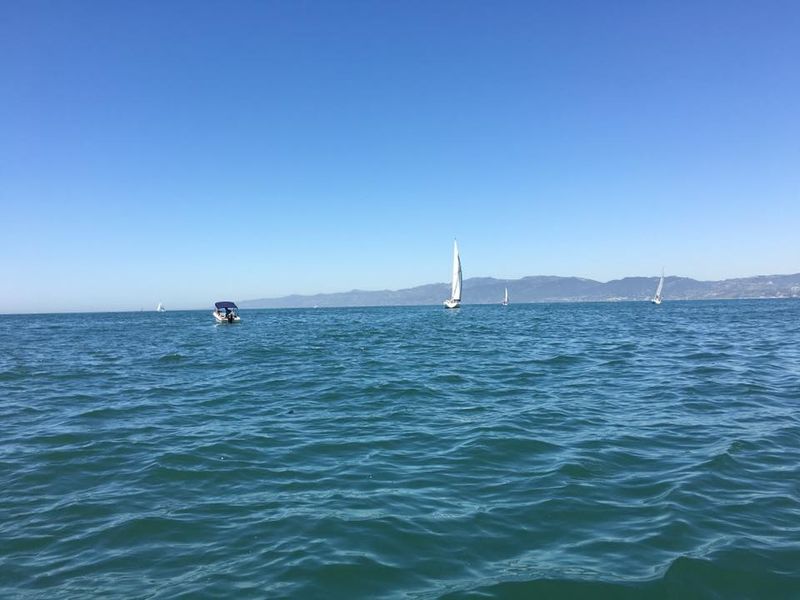
“To study the phenomena of law in society without books is to sail an uncharted sea, while to study the law without clients is not to go to sea at all.” – Professor Charles Henderson Miller, founder of the University of Tennessee legal clinic in 1947.